

We Celebrate the Romani Language. So Why Are Its Speakers Still Excluded?
Beyond the Gatekeepers: Reclaiming Romani Voices, Knowledge and Power
World Romani Language Day | 5 November 2026
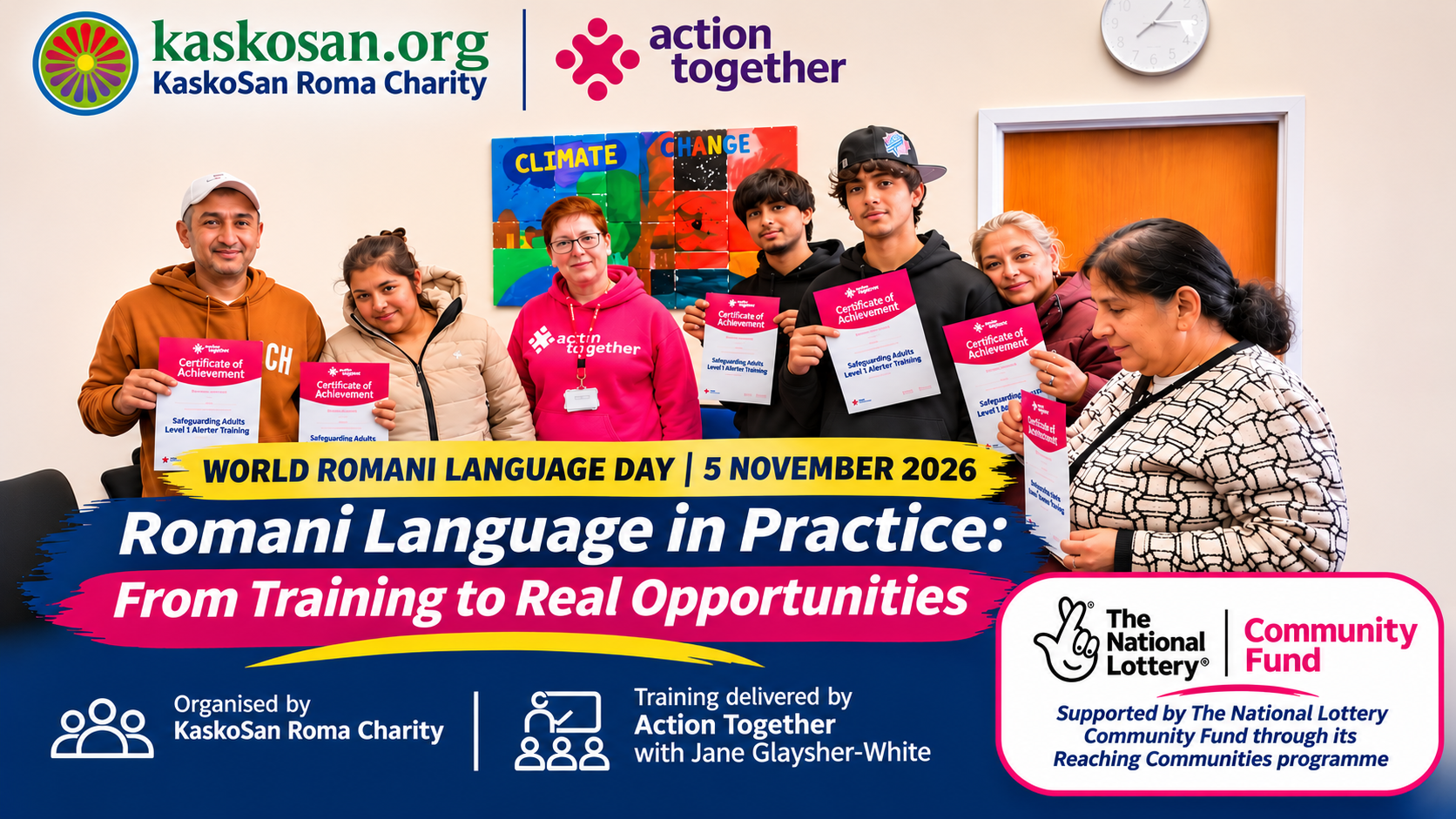
Romani language opening doors to professional training: Rochdale Roma volunteers completed Safeguarding Adults Level 1 training in their first language, Carpathian Romani, delivered by Jane Glaysher-White, Development Worker at Action Together, on 28 October 2026.
On World Romani Language Day, I want to challenge a contradiction at the heart of Roma inclusion.
We celebrate our language, promote its recognition and speak proudly about preserving it. Yet across the very institutions and programmes claiming to represent us, the Romani varieties our communities actually speak are too often absent from decision-making, professional opportunities and leadership.
Organisations report to funders. Professionals speak at conferences. Strategies are written, evaluations published and millions spent in the name of Roma inclusion.
But who speaks for the communities themselves? Who understands their languages, cultural knowledge and traditions? And who is accountable to the people in whose names these programmes exist?
What if one of the biggest barriers to meaningful Roma inclusion is the way the Roma inclusion industry itself operates?
The international Roma movement has achieved something important. It has helped secure recognition for peoples whose languages, histories and identities have endured centuries of persecution, exclusion and attempts at assimilation.
But recognition is not the same as power.
I have worked as a Romani interpreter and translator since 1989. Over those years, I have watched Roma inclusion become increasingly professionalised. We now have strategies, frameworks, conferences, research programmes and organisations dedicated to advancing Roma rights.
These developments have created opportunities. But they have also created new hierarchies.
Has a movement intended to unite and empower our peoples gradually become an institutional category, increasingly shaped by policies, funding priorities and a growing class of “professional Roma”, rather than by the communities themselves?
And what happens when the people who know their communities best are the least likely to be invited into the room?
Whose identity are we recognising?
The word Roma has become an internationally recognised umbrella term. But the peoples placed beneath that umbrella are not culturally, linguistically or historically identical.
There are Sinti, Romanichal, Romanisæl, Boyash, Lovari, Kalderash, Ursari, Ashkali and many other communities. Some identify as Roma; others have different understandings of their identity and belonging.
Among British Romany Gypsies, for example, some identify as Gypsies or Travellers rather than Roma. Some traditional musician communities in Hungary identify primarily through their musical traditions rather than through an externally imposed ethnic category.
Even the words we use for ourselves are not always understood in the same way.
In my own Russian-Serbian Lovari variety, Rom can refer to a mature, married man and is also used as a plural form. Roma is not traditionally the plural we use.
This is not an argument against a shared Roma identity. It is a reminder that international terminology cannot simply replace the identities communities have developed and maintained over generations.
Nor should traditional Romani groups be confused with nationalities.
Lovari and Ursari families may come from the same country while speaking different Romani varieties and maintaining distinct social traditions. Members of the same traditional group may live across several countries.
These distinctions matter because identity is connected to relationships, trust, responsibilities, customary practices and belonging.
In discussions surrounding the international Romani Kris, I have seen thousands of people engage with questions of traditional identity, responsibility and community relationships. Some live discussions attract audiences of ten or twenty thousand or more, while recordings reach many more.
Yet how often does this knowledge influence the policies and programmes designed for our communities?
Our traditions are not beyond criticism. Discrimination and exclusion can exist within Romani communities too.
But recognising these problems should not mean dismissing the communities themselves as incapable of defining their identities or contributing their own knowledge.
We should also ask whether divisions between our peoples have sometimes been exploited by those who benefit from keeping us fragmented.
Divide et impera. Divide and rule.
Can we build unity without making our differences invisible?
One language, many varieties. But whose Romani?
Romani is an Indo-Aryan language with a rich history and many varieties, including Lovari, Kalderash, Ursari and Carpathian Romani.
Efforts to develop a common or standardised Romani language are valuable. They can support education, literature, communication and international recognition.
But what happens when the Romani used by institutions, translators or international programmes is not understood by the people those programmes are intended to reach?
Over nearly four decades of interpreting and translation work, I have repeatedly witnessed misunderstandings and mistranslations, including at international conferences where Romani interpretation is provided.
Participants have approached me over the years because they struggled to understand the interpretation being offered, despite speaking Romani themselves.
These experiences raise an important question:
How meaningful is participation when people cannot be confident that they are being accurately understood, or that they fully understand what is being communicated?
Accurate interpreting requires more than fluency in Romani. It demands an understanding of dialectal variation, cultural context and the professional responsibility to ensure that meaning is conveyed faithfully.
A seat at the table means little if your words arrive there carrying somebody else’s meaning.
The same problem arises when institutions assume that someone’s nationality determines their preferred language.
A Romani person from Slovakia may be offered Slovak interpretation. Someone from Romania may be expected to communicate in Romanian.
But what if neither is the language in which they can most confidently explain their experiences, understand sensitive information or make important decisions?
For some, majority languages may also carry painful associations with discrimination, humiliation or institutional oppression.
Language access is not simply about providing an interpreter. It is about ensuring understanding, trust and meaningful participation.
This becomes particularly important in safeguarding, healthcare, education, social care and the justice system.
And language cannot be separated from culture.
Concepts such as Romanipe, encompassing Romani identity, values and ways of life, and Pachiv, associated with respect, honour and social obligations, can be essential to understanding how trust and responsibility operate within communities.
Their meanings and expressions vary between groups. They cannot simply be reduced to a few translated words in a training manual.
If we celebrate Romani as a language of identity, why do we so rarely treat its locally spoken varieties as languages of professional knowledge, learning and authority?
What happened in Rochdale?
On 28 October 2026, KaskoSan facilitated a four-hour Safeguarding Adults Level 1 Alerter Training session in Rochdale.
The training was delivered by Jane Glaysher-White from Action Together, who has supported our community work since 2013.
Dominik, a young Romani interpreter who grew up in Rochdale, interpreted the training into Eastern Slovak Carpathian Romani.
The participants were first-language Romani speakers. They completed the training and received certificates that can support their development as community volunteers.
What made this important was not simply that a training course had been translated.
The participants could learn through the language they already spoke, rather than having to demonstrate proficiency in English or Slovak before being considered capable of learning.
The training maintained its professional content and safeguarding standards. What changed was the route through which people could access it.
Why should this be unusual?
Why should a community member’s knowledge, experience and willingness to contribute be overlooked because they cannot navigate a training programme delivered in an unfamiliar institutional language?
And how many potential community advocates, safeguarding volunteers and future professionals have we lost because we never gave them the opportunity to begin?
This is what Romani language recognition should look like in practice.
Not simply a celebration, a translation or a symbolic acknowledgement, but a route into learning, qualifications, employment and responsibility.
Who gets to be an expert?
Formal education matters. Professional qualifications matter. Research, safeguarding standards and ethical practice matter.
But why have we allowed institutional qualifications to become such dominant measures of expertise that first-language Romani fluency, cultural understanding and genuine community trust can be treated as secondary?
There are Romani people who may never have attended university but possess extraordinary linguistic, cultural and social knowledge.
They understand the relationships between traditional groups, the differences between spoken varieties, the expectations surrounding trust and respect, and the ways information travels through their communities.
Should that knowledge count for less because it was not acquired in a university?
At the same time, we need more professionally trained Romani interpreters, translators, researchers, journalists, broadcasters, presenters, educators and community leaders.
Many young Romani people who have grown up in Britain already speak English and their family’s Romani variety at a very high level. Some have spent years interpreting informally for relatives and neighbours.
That experience can provide a foundation, but professional interpreting requires much more. It demands training in ethics, accuracy, equivalence, confidentiality and professional boundaries.
In 2023, Maria and I attended the first Romani-Translation Summer Institute at Concordia University in Montréal, organised by Professor Debbie Folaron.
We participated in and contributed to workshops alongside Romani linguists, translators, interpreters and other specialists.
Experiences like this demonstrate what becomes possible when academic expertise and community knowledge meet.
Neither should replace the other.
We should be creating pathways through which people who already possess linguistic and cultural knowledge can gain professional skills, qualifications, employment and influence.
And we should be investing in Romani journalists, bloggers, broadcasters and social media communicators who can produce information in the varieties their communities actually understand.
We need more Romani professionals, not simply more “professional Roma” representatives.
There is an important difference.
By “professional Roma”, I mean the growing institutional practice of recognising people as community representatives primarily because of their positions, qualifications or access to organisations, without necessarily establishing whether they possess the linguistic knowledge, community relationships or accountability that meaningful representation requires.
This is not a criticism of Romani professionals. We need more of them.
It is a challenge to the assumption that institutional status automatically confers community legitimacy.
Accountable to whom?
Across the Roma inclusion sector, organisations are expected to demonstrate accountability to their funders.
They submit budgets, monitoring returns, evaluations, financial reports and evidence of outcomes.
That accountability is necessary.
But there is another question we rarely ask with the same seriousness:
How accountable are these organisations to the Romani communities in whose names they receive funding?
How many community members know what funding was awarded, what activities were promised, how money was spent and what was actually achieved?
How often are these matters explained in the Romani varieties people speak?
And how frequently do communities have a genuine opportunity to challenge decisions or change priorities?
Reports may be publicly available, but often only in English or another majority language, written in the technical vocabulary of policy, finance and programme management.
Something can be publicly accessible without being meaningfully accessible.
We have created systems in which accountability is largely defined by institutional expectations, while the linguistic and cultural practices through which Romani communities communicate are too often overlooked.
If a project is funded in the name of a community, that community should have the right to know what was promised, what was spent and what was achieved.
Not merely through a website or an annual report.
Through conversations, meetings and information they can actually understand, with opportunities to question, disagree and influence what happens next.
This principle must apply to KaskoSan too.
Otherwise, we risk creating a new generation of gatekeepers while claiming to challenge the old ones.
When Romani becomes the language of the room
KaskoSan began in 2008 as a Romani-language social network, eventually growing to around half a million users.
We formally established our organisation in 2014, and much of our work over the following years was sustained through volunteering.
One of the most important decisions we made was to stop treating Romani as an occasional translation requirement.
Instead, we began making the locally spoken Romani varieties the primary working languages of our community activities, conversations, learning and decision-making.
This changed the atmosphere.
People who had remained silent in English-language institutional settings began speaking openly.
Some became emotional, even crying, as they shared experiences that they had previously struggled to express.
Others began questioning decisions, contributing ideas, supporting one another and taking responsibility for activities.
It was not because we had suddenly discovered their abilities.
Those abilities were already there.
What had changed was the environment.
Their language was not a problem to be accommodated. It was the language of the room.
We were not there to give people a voice. They already had one.
We wanted to create the conditions in which they felt able to use it.
This experience has shaped our approach to recruitment and community leadership.
We want to begin by recognising people’s fluency in the Romani varieties spoken locally, their understanding of Romanipe and Pachiv, their cultural knowledge and the trust they have earned within their communities.
Professional training, English-language skills and institutional procedures can then be developed alongside these strengths.
This does not mean abandoning professional standards.
It means questioning why the knowledge people already possess is so rarely treated as the foundation on which those standards can be built.
Our ambition is to turn the existing hierarchy on its head: to make Romani linguistic and cultural knowledge the starting point for recruitment, leadership and professional development, rather than an optional extra.
Building the future from within
Through our three-year National Lottery Community Fund Reaching Communities project, Empowering Roma Communities in Greater Manchester, KaskoSan is working to develop community advocates, strengthen participation and create pathways towards professional opportunities.
Our organisation brings together members and leaders from traditional Romani groups, including Lovari, Kalderash, Ursari and Carpathian Romani-speaking communities.
These are not simply labels used to demonstrate diversity in a funding application.
They are people whose languages, histories, relationships and knowledge are part of the organisation itself.
We want to see community members become trained advocates, interpreters, safeguarding volunteers, researchers, communicators and decision-makers.
And we want the institutions working with them to recognise the value of the knowledge they already hold.
During a visit to Canada, I was struck by the recognition given to First Nations, Inuit and Métis peoples, and by the distinct identities, languages and histories of different First Nations.
Their legal, historical and political circumstances are not the same as those of Romani communities.
Nevertheless, the experience raised an important question for me.
Could our shared Roma identity become stronger by recognising, rather than overlooking, the distinct identities of our traditional groups?
Could we build a movement that embraces the different languages, histories and community structures of our peoples, instead of expecting everyone to fit into one institutional definition?
Perhaps our unity would be stronger if it did not depend on making our differences invisible.
Beyond celebration
World Romani Language Day should be a celebration.
Our language has survived persecution, forced assimilation, exclusion and generations of pressure to abandon it.
That survival is extraordinary.
But celebration alone is not enough.
We should also be asking:
Who is being trained?
Who is being employed?
Who is interpreting in our hospitals, schools, councils and safeguarding services?
Who is producing news, research and educational resources in the Romani varieties people actually speak?
Who controls the resources allocated in our names?
Who chooses our representatives?
And who is accountable to the communities themselves?
The international Roma movement has helped secure recognition. That achievement matters.
But perhaps it is time to measure progress not only through recognition, conferences and institutional representation, but through the opportunities, responsibilities and decision-making power that reach our communities.
Our next struggle must be to make the Romani varieties our people actually speak the languages of participation, professional opportunity and leadership.
Why should our communities have to abandon the languages, knowledge and cultural traditions they are familiar with simply to take part in decisions about their own lives?
Why shouldn’t institutions learn to work with that knowledge instead?
When people can learn, participate and lead through the languages and cultural frameworks they know, they are no longer dependent on others to speak for them, interpret their needs or determine their priorities.
They can take their rightful place in making decisions, building institutions and forging their own future.
Juice Vamosi
Founder and Chief Executive Officer
KaskoSan Roma Charity
KaskoSan CIO | Registered Charity No. 1206113
World Romani Language Day, 5 November 2026
This article draws on my experience as a Romani interpreter, translator and community organiser, and on KaskoSan’s work with Romani communities in Greater Manchester. Our Reaching Communities project is supported by The National Lottery Community Fund.