The Romanipe Identity Model
Juice Vamosi
Language Consultant
KaskoSan Charity
Abstract
This article introduces the Romanipe Identity Model, a conceptual framework for understanding the fluid and relational nature of Romani identity. The model conceptualises identity as emerging through the dynamic interaction of key cultural elements, including language, pachiv, kris and traditional occupations. These elements are situated within broader historical processes such as migration, linguistic contact and the long-term impact of antigypsyism. The framework highlights variation across Romani communities as the outcome of complex historical trajectories rather than deficit, offering a nuanced approach applicable in research, policy and community practice.
Keywords
Romani identity, Romanipe, Roma communities, antigypsyism, cultural identity, migration, linguistic contact, community studies
Introduction
Romani identity is often discussed in simplified or static terms. However, lived experience across Romani communities demonstrates that identity is neither fixed nor uniform. Instead, it is shaped by a complex interaction of cultural, historical and social factors that vary across time, place and group experience.
This article introduces The Romanipe Identity Model, a conceptual framework designed to understand the dynamic and relational nature of Romani identity. The model brings together key cultural dimensions and situates them within broader historical processes, including migration, linguistic contact and the long-term impact of antigypsyism.
The Model (Summary)
Romani identity can be understood as a fluid system shaped by interconnected elements, including language, pachiv, kris and traditional occupations.
These elements interact dynamically and are not uniformly present. Identity emerges through their relationship rather than from any single component.
The configuration of these elements varies across individuals and groups, shaped by cultural continuity as well as the long-term effects of antigypsyism, differing migration trajectories and diverse contact environments.
Visual Representation of the Model
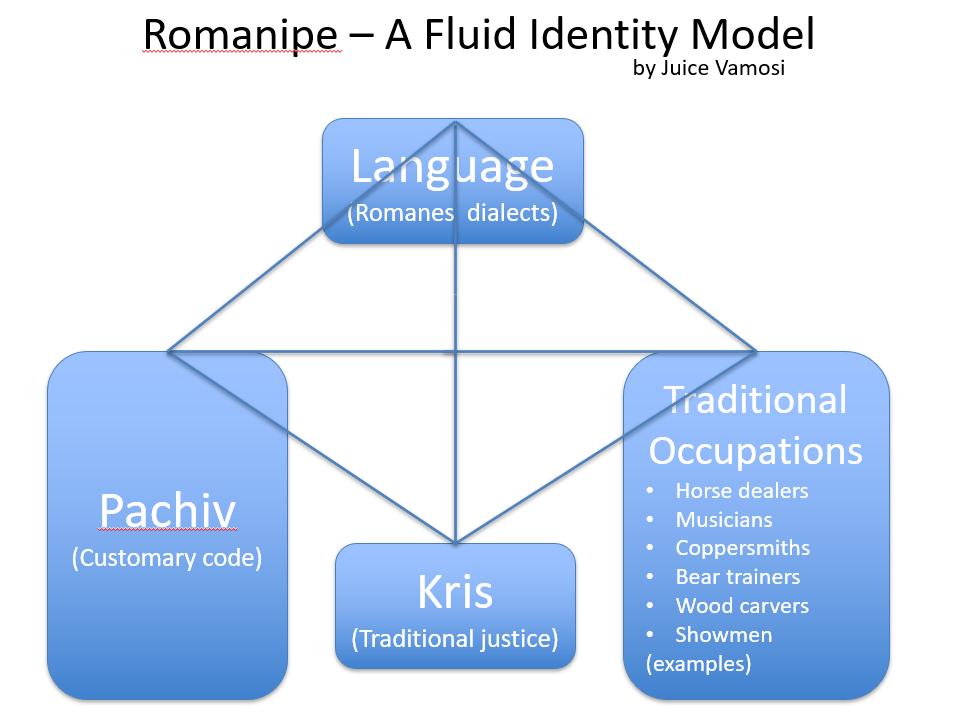
Title: Romanipe – A Fluid Identity Model
Conceptual Framework
Romani identity can be understood as a fluid and relational system composed of interconnected elements, including language, pachiv, kris and traditional occupations. These elements do not exist in isolation but interact dynamically, shaping identity across time, place and individual experience.
The presence, strength and interaction of these elements vary between individuals and groups. No single element defines identity in isolation. Instead, identity emerges through the ongoing relationship between these dimensions, which may be preserved, adapted or diminished in different ways.
Language, for example, may continue to carry cultural identity even where traditional occupations or kris are no longer active. Pachiv is often expressed and reinforced through language and everyday social practice. Kris, where present, typically integrates both language and pachiv. Traditional occupations, even where no longer practised in their original form, may continue to shape identity through memory, values, skills or partial continuation, including the persistence of Romani-derived expressions within dominant languages.
At the same time, this system is shaped by broader historical processes. Differing migration trajectories and historically contingent pathways of settlement and interaction have played a fundamental role in shaping identity. As Romani communities moved across regions, they came into contact with a wide range of languages and cultures, resulting in varying degrees of linguistic borrowing, structural change and cultural adaptation.
These contact environments have influenced the extent to which linguistic and cultural features have been maintained, transformed or lost across groups.
In addition, centuries of antigypsyism, including processes of exclusion, forced assimilation and structural discrimination, have significantly impacted the continuity of these elements. This has contributed to varying degrees of language and cultural loss, alongside patterns of differential preservation across communities.
As a result, the configuration of identity within this model is not uniform. Some groups have retained stronger continuity across multiple elements, including language, social norms and traditional practices, while others have experienced partial or substantial erosion of these dimensions. Groups often described as more culturally conservative may preserve a greater number of these elements, whereas those more exposed to assimilation and structural marginalisation may exhibit more fragmented or transformed configurations.
Romani identity should therefore be understood not as fixed or singular, but as fluid, evolving and shaped by both internal cultural continuity and external historical forces.
Conclusion
The Romanipe Identity Model offers a framework for understanding Romani identity beyond static definitions and deficit-based narratives. By recognising the interaction between cultural elements, historical migration, linguistic contact and the structural impact of antigypsyism, the model provides a more accurate and nuanced understanding.
It also highlights that variation across Romani communities does not represent a loss of identity, but rather reflects complex historical processes, including both erosion and differential preservation. As such, the model can be applied in education, policy, research and community practice to support more informed and respectful engagement with Romani experiences.
Attribution
Juice Vamosi
Romanipe – A Fluid Identity Model

